Disclaimer: I am not a dating coach nor am I selling any dating products or services this blog is really for recreational usage to reflect on my previous experiences in daygame and to share my insight. I have no affiliation with any of the authors on any of the books I’ve reviewed on this website- For for those who want to network in the future please email: jeremysergent361@gmail.com thanks – Article Written by Jeremy Sergent
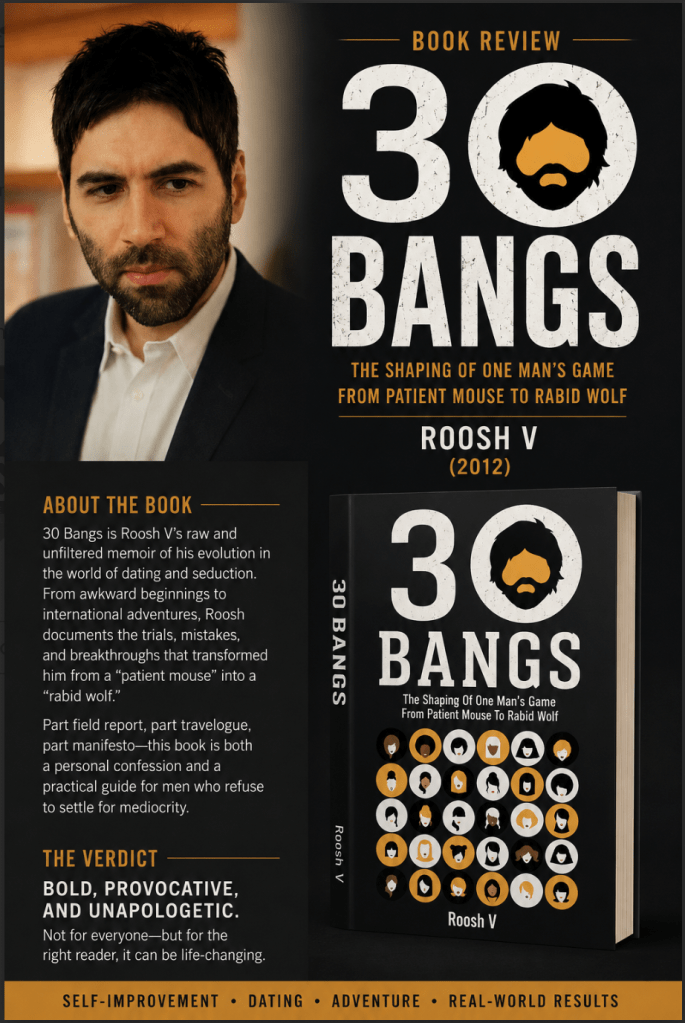
In terms of cultural impact, few figures in the world of pickup artistry have had as much influence as Roosh V. At his peak, he claimed millions of monthly views on his dating blog while also building the infamous Roosh V forum. His impact on the online seduction space was undeniably huge and, despite his later conversion to Christianity and departure from “game,” his influence will likely always be remembered as significant.
30 Bangs is essentially a collection of lay reports documenting his experiences with daygame across the United States. The book gets straight to the point: there is no emotional backstory, no traumatic childhood narrative, and very little introspection. Instead, it reads almost like the detached diary of someone clinically documenting seduction encounters. There is little emotional depth or tactical analysis throughout the reports. Most are extremely short, often only one or two pages, and there is almost no emotional connection established with the women involved.
Roosh V comes across as an honest person. He is one of the few pickup artists whom I genuinely trust to write accurate and truthful lay reports. He never struck me as the type to fake results or aggressively sell questionable boot camps and low-quality dating products. His eventual conversion to Christianity and abandonment of seduction may have been connected to the death of his sister, or perhaps it reflected a deeper dissatisfaction with the lifestyle itself. Such a radical shift toward religion can sometimes suggest a search for meaning or refuge from the emptiness of hedonism. Alternatively, he may simply have reached a point where he thought, “enough is enough,” and walked away from it entirely.
Regardless, it is difficult to overstate the scale of his influence. At his peak, he was generating millions of views as a pickup blogger, which is an extraordinary achievement. To put that into perspective, I have accumulated roughly 50,000 hits over five years, and it would probably take me decades to match the traffic Roosh could attract in a single month during his prime. That level of reach may never be replicated, especially in today’s fragmented social media landscape, where it is far harder for a pickup artist to build such a concentrated audience.
Many of the encounters described in the book take place in oddly old-fashioned circumstances. Around 75 percent of the book is set in the United States, with the remaining portion taking place in Latin America. There are numerous long drives, AIM messages, and forum-based interactions that feel very much of their era. One particularly unusual example involves Roosh sleeping with a woman he met through a seduction forum after corresponding with her online.
The emotional emptiness Roosh later discussed in interviews after retiring from the game is already visible in this book. Most of the reports are written in such a detached and clinical manner that it is difficult to imagine him genuinely caring about the women involved. It often feels as though he is simply going through the motions. He appears unwilling—or perhaps unable—to add emotional depth to his writing, similar to the issues Sasha Daygame had in The Direct Daygame Bible. This is one reason why I personally rate writers such as Nick Krauser, Liam McRae, and James Marshall above him; they were far better at bringing emotional nuance and storytelling into their work.
There is also very little discussion of technique or systemisation. The book mainly consists of short lay reports describing nights out, interactions at bars, and sexual encounters afterward. Beyond that, there is not much instructional value.
One of the more memorable moments in the book occurs when Roosh meets one of his female blog critics and ends up sleeping with her. That is a fairly remarkable scenario, and one that feels difficult to imagine happening today. Personally, I cannot picture engaging romantically with a blog follower, though Roosh operated during a very different internet era. By 2012, he had built a substantial following, and his criticisms of feminism appeared to attract a surprisingly large female readership, some of whom were evidently interested in him romantically.
The latter half of the book takes place in South America, particularly in Brazil and Colombia. Like many figures in the seduction space—such as Tom Torero, Nick Krauser, John Anthony, and James Marshall—Roosh gravitates toward regions where the dating market appears easier and where lower social value may still yield strong results. I also found Latin America noticeably less demanding than Western cities in terms of dating expectations. Some of the Brazilian women I met would likely have had dramatically different dating lives had they lived in Europe or North America.
One particularly bleak encounter involves Roosh sleeping with a Colombian woman who appears to be living close to poverty and still resides with her mother. After several more encounters in Brazil, the book ends rather abruptly, closing with only a couple of pages of underdeveloped advice.
In Deplorable Cad, Nick Krauser described his frustrations with Roosh as someone who could have become much more than he ultimately did. Krauser portrayed him as honest but lacking the unique charisma and emotional energy that distinguished the very best daygamers. After reading 30 Bangs, it is difficult not to see some truth in that assessment.
Overall, I am not sure there is much even a beginner can truly learn from this book. Roosh’s rise to prominence was undoubtedly interesting and, in some ways, inspiring, but he lacks the writing ability necessary to become a genuinely memorable author. He is simply too emotionally detached. Reading the book, it is difficult to reconcile its flat tone with the enormous audience he once commanded.
If Roosh were starting today, I doubt he would attract even a fraction of the audience he had in 2012. His style belongs to a very particular internet era that no longer exists. Ultimately, I think 30 Bangs is a disappointing book by a considerable margin. When reading authors such as James Marshall or Nick Krauser, you often find yourself emotionally invested in their journeys and genuinely wanting them to succeed in relationships and dating. With Roosh, however, the experience feels closer to reading an American Psycho-style account of casual sex devoid of emotional substance.
That emotional emptiness leaves the reader unsatisfied. The book neither inspires deeper connections nor offers meaningful guidance on how to create them. At the same time, it is worth remembering the context in which it was released. In 2012, Roosh was near the height of his popularity. He probably could have released almost anything and still sold copies successfully. As a result, there may have been an element of complacency—simply releasing products because the demand existed.
Today, Roosh V lives as a dedicated Christian and openly criticises the pickup lifestyle, claiming that it left him feeling empty. Yet, regardless of how he now views that period of his life, pickup artistry undeniably gave him unique life experiences and a legacy few others in the niche achieved. I simply think that, in the decade following his peak, more talented writers and speakers emerged whose work largely surpassed his. For beginner seducers, I would recommend the works of Tom Torero, Liam McRae, James Marshall, Nick Krauser, and DJ Fuji long before I would recommend Roosh’s emotionally detached lay reports.
Score: 3/10
For more on Roosh V’s legacy: https://rooshvforum.org/

Leave a Reply